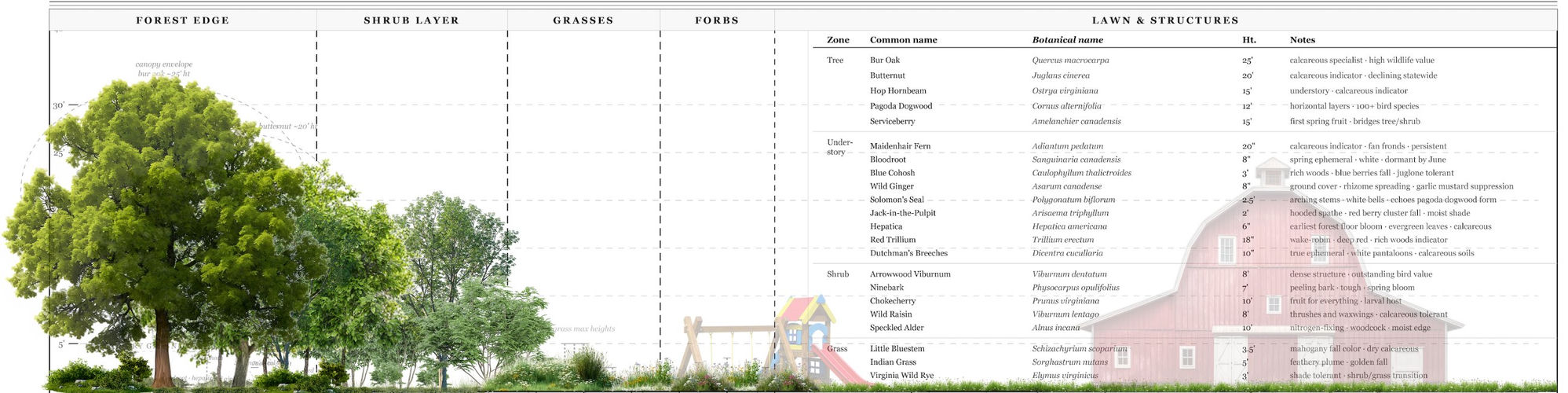
In functional ecological systems, the richest biodiversity occurs not at the center of habitat types, but at the transitions between them — the riparian edge, the woodland margin, the shrub corridor dissolving into meadow. These are gradients, not boundaries. The practice is named for this principle, and it shapes every design decision we make.
Where conventional landscape design draws a hard line between maintained lawn and planted area, Gradients designs the full sequence — from forest canopy through shrub layer, into grasses and forbs, to the structures and spaces where people live and work. Every zone is functional. Every transition is intentional.
A single property, no matter how well-designed, cannot sustain species persistence in isolation. What determines whether individual habitat patches become functional ecological systems is connectivity — how they relate to corridors, riparian networks, adjacent conservation lands, and the regional landscape as a whole.
This is not a metaphor. It is the literal problem we design for. Every project begins with the question: what does this property need to do to be part of something larger than itself?
21st century conservation cannot be practiced as if people and nature occupy separate spheres. The landscapes we design are lived in, worked on, and loved. The communities whose landowners we work with hold conservation potential that policy alone cannot unlock.
The design process is where that potential becomes legible — where a landowner becomes a steward, and a steward becomes an advocate, and an advocate becomes part of the science and policy that shapes what conservation looks like for the next generation.
Every species in the palette is chosen against a specific set of conditions — soil pH, drainage, light, disturbance history, regional context. Vermont Valley calcareous soils are demanding and distinctive: they select hard, reward precision, and support species assemblages found nowhere else in the Northeast.
Butternut, Bur Oak, Maidenhair Fern, Red Trillium — these are not ornamental choices. They are indicators. Their presence in a well-functioning design is a measurement of how well the underlying ecological logic holds. The palette is the hypothesis. The landscape is the test.
The zone-by-zone structure of every Gradients design is deliberate. Forest Edge into Shrub Layer into Grasses into Forbs into the managed edge — each transition is its own habitat type, each supporting different species assemblages, different seasonal functions, different relationships to adjacent zones.
What looks like a designed landscape is actually a managed gradient. The goal is not a fixed aesthetic but a trajectory: a landscape that becomes more complex, more functional, and more ecologically integrated over time — one that earns its place in the larger regional system it is part of.
The best starting point is a conversation about your property, your goals, and the landscape it's part of.
Start a ConversationHeather Davis Miller · Founder & Executive Director
heather@justconservationsolutions.com